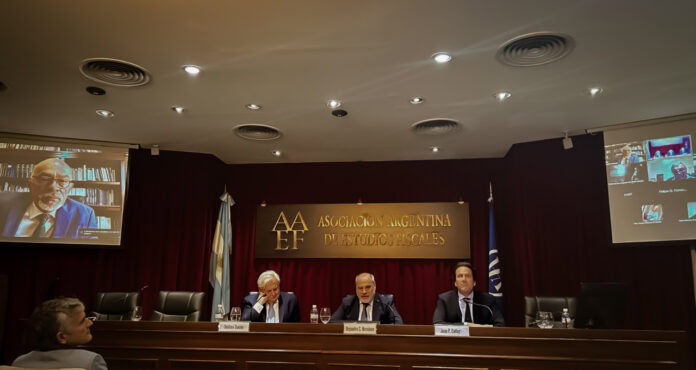
International trade and geopolitical disputes were the central themes of the roundtable organized by the Argentine Association of Fiscal Studies (AAEF) on May 5, 2025, in Buenos Aires. The event, held in a hybrid format, brought together prominent academics from Argentina, Uruguay, and Mexico to reflect on the economic challenges in a global scenario marked by uncertainty.
Given its commitment to research, analysis, and improvement of the tax system, it's no surprise that the AAEF has launched this event with the goal of continuing to promote comprehensive approaches alongside the academic and professional community. Within this framework, the panel was moderated by Dr. Juan Patricio Cotter, who offered a valuable insight into the context of the multilateral order.
✔Juan Cotter – An opening with historical perspective
Dr. Cotter recalled that, after the World Wars and the Great Depression, Western powers promoted a new multilateral order that gave rise to the contemporary global economic system, with milestones such as the Bretton Woods Agreements, the creation of the UN, the GATT, and, later, the World Trade Organization (WTO). “There has never been a period of such stability and progress in human history,” he emphasized. However, he warned that this balance was altered with the launch of the doctrine America First, on February 21, when "the exception began to become the rule." With these words, the academic opened the debate proposed by the AAEF on the challenges of international trade and geopolitical disputes in the current scenario.
✔Gustavo Zunino – The United States and the protectionist turn
Following this introduction, Dr. Gustavo Zunino—former president and Honorary Member of the AAEF—offered a presentation that was described as "masterful." The jurist provided a detailed analysis of the current state of U.S. trade policy, focusing on the implications of the measures implemented during the Donald Trump administration and their implications under the new strategic approach.
The Argentine exhibitor defined the current scenario as a true "state of art"In terms of regulations, highlighting how this moment represents a significant break from the multilateral order that has prevailed in international trade for the past few decades. In his view, "we are facing a paradigm shift that challenges the multilateral system established after World War II."
He highlighted how U.S. tariff policy has tightened dramatically since February, with the imposition of 10% and 25% tariffs on a wide range of imported products, including steel, aluminum, auto parts, and goods from countries without reciprocity agreements. “There’s no doubt we’re seeing a trade strategy based on confrontation, not cooperation,” he stated.
One of the central points of his analysis was the instrumentalization of national security as a commercial justification, alluding to the fact that certain inputs are essential for defense, and to a supposed loss of industrial capacity to foreign competitors. "The argument of national security is being used to close markets and regain industrial sovereignty," he explained.
In addition, he warned about the introduction of additional tariffs of up to 100% for products from certain industries (such as logistics and cinema) and countries considered "non-cooperative," an initiative still subject to renegotiation. "These types of measures are far from the spirit of the WTO and bring us closer to a trade war scenario," he warned.
The specialist emphasized that these policies seek not only to protect jobs and reactivate domestic US investment, but also to review current trade agreements, such as the USMCA, to adapt them to a new nationalist and defensive logic. According to Zunino, "what is being discussed is not just economics: it's sovereignty, power, and decision-making capacity." With this statement, the specialist emphasizes that the reorientation of trade policies is deeply linked to a redefinition of the role of the state in the economy and international politics.
Zunino warned that the protectionist shift redefines countries' domestic priorities and increases global uncertainty by challenging the rules of world trade. "It's a paradigm shift that calls into question the multilateral agreements of recent decades," he stated. This forces the major economic blocs to rethink their strategies in the face of a more unpredictable and fragmented trade order.
✔Pablo Labandera – Impacts on the multilateral legal regime
Dr. Pablo Labandera, a doctor in Law and International Relations and professor at prestigious academic institutions in Uruguay, gave a presentation structured around four pillars on the current status of the multilateral trade legal regime.
1. Geopolitics and uncertainty in international trade. He began by describing an international landscape marked by growing conflict, both commercial and military, with focal points in Ukraine, the Middle East, and Africa. He noted that international trade is severely affected by these situations, especially by the fragility of strategic points such as the Strait of Hormuz, "through which approximately 30% of the world's oil trade passes." He defined this passage as a "potential bottleneck" for global trade and warned that "beyond the debate between globalization and deglobalization, what predominates is economic interdependence," a reality that generates uncertainty and reshapes global production chains.
2. The United States and the rethinking of its global role.Labandera explained that the U.S. strategic shift, which has deepened since the Trump administration, is a response to structural factors. He cited a statement by Stefan Miran, a former economic advisor to Trump, arguing that the country has historically financed two global public goods: international security and the dollar as a reserve currency.
3. Consequences for the multilateral trading system. This US strategic shift, coupled with protectionist measures and industrial relocation processes, has weakened the multilateral trading system created after World War II. “There is no longer a consensus on the rules of the game,” Labandera said, highlighting the erosion of a legal regime that for decades guaranteed predictability and cooperation.
4. Legal concerns and need for adaptation. In conclusion, Labandera called for a rethinking of the regulatory framework for international trade in light of this new global configuration. He stated that the multilateral regime "faces unprecedented challenges" and emphasized the importance of not abandoning the principles of international trade law, but rather adapting them to a changing world, where systemic tensions and national interests are reshaping global economic power.
✔Andrés Rohde Ponce – Customs territory and geopolitical disputes
From Mexico, Dr. Andrés Rohde Ponce, president of the International Academy of Customs Law, was the third speaker. He addressed geopolitical disputes in international trade from a historical and conceptual perspective, clearly integrating the previous contributions of his colleagues.
Dr. Rohde began his presentation by defining geopolitics as "the policy that a State develops in response to its geographical location," and directly linked this concept to that of customs territory, emphasizing that the latter is not a static notion.Customs territories have been constantly reconfigured", he explained, in line with the transformations in global trade.
Using a historical perspective, Rohde illustrated how geopolitical conflicts and strategies have shaped both territorial spaces and trade dynamics. He mentioned early examples such as the Turkish merchants who established a free trade zone over 3.000 years BC, and the Silk Road, which he described as a "journey of changing goods" rather than a continuous route. He also compared the geopolitical vocations of Spain and England in the Americas: while the Spanish focused on mining, the English favored the development of port enclaves geared toward trade.
Regarding the global reconfiguration following the World Wars, Rohde noted that the signing of the GATT in 1947 marked the beginning of free and multilateral trade. However, he criticized the failure of the multilateral rounds of negotiations since 1994, especially on issues such as agricultural tariffs.
Rohde highlighted the lack of transparency in current trade policies. He also highlighted the replacement of the Most Favored Nation principle by rules of origin, revealing that more than 60% of global trade is no longer covered by this principle, as evidenced by the 70% of intraregional trade within ASEAN.
Rohde highlighted the historical success of the GATT, emphasizing its flexibility as key to the growth of global trade between 1950 and 2024. He explained that the GATT offered a set of obligations with exceptions for each state, allowing international trade to remain functional even during the 2008 financial crisis and the 2020 pandemic.
He also addressed current challenges in e-commerce, mentioning that the WTO established a moratorium on the taxation of e-commerce, but warned about the elimination of the tax regime. de minimis by Trump, which could have a negative impact on international trade.
Dr. Rohde addressed the relationship between Mexico and the United States, highlighting how the USMCA has provided protection to Mexico, especially in the face of Trump's policies, and has contributed to economic stability. He emphasized that bilateral trade is guided by the principle of "import substitution" and explained that Mexico's temporary exports influence the United States' trade balance.
Finally, Rohde proposed rethinking the concept of customs territory, pointing out that the "commercial territory of the United States includes part of Mexican territory," which opens the possibility of an "imperfect, incomplete and gradual customs union" between the two countries..
✔Alejandro E. Messineo – Institutional closure
Dr. Alejandro E. Messineo, president of the AAEF, provided the closing remarks, thanking the presenters and emphasizing that, although there were no definitive conclusions, "we leave with interesting reflections." He concluded by thanking the organizers and stating that "this topic is just beginning," opening the door for further collaborative reflection.

Aduana News is the first Argentine customs newspaper to launch its digital version. With 20 years of experience, its publications and initiatives aim to provide the most relevant knowledge on customs issues in order to contribute to safe trade in the region.