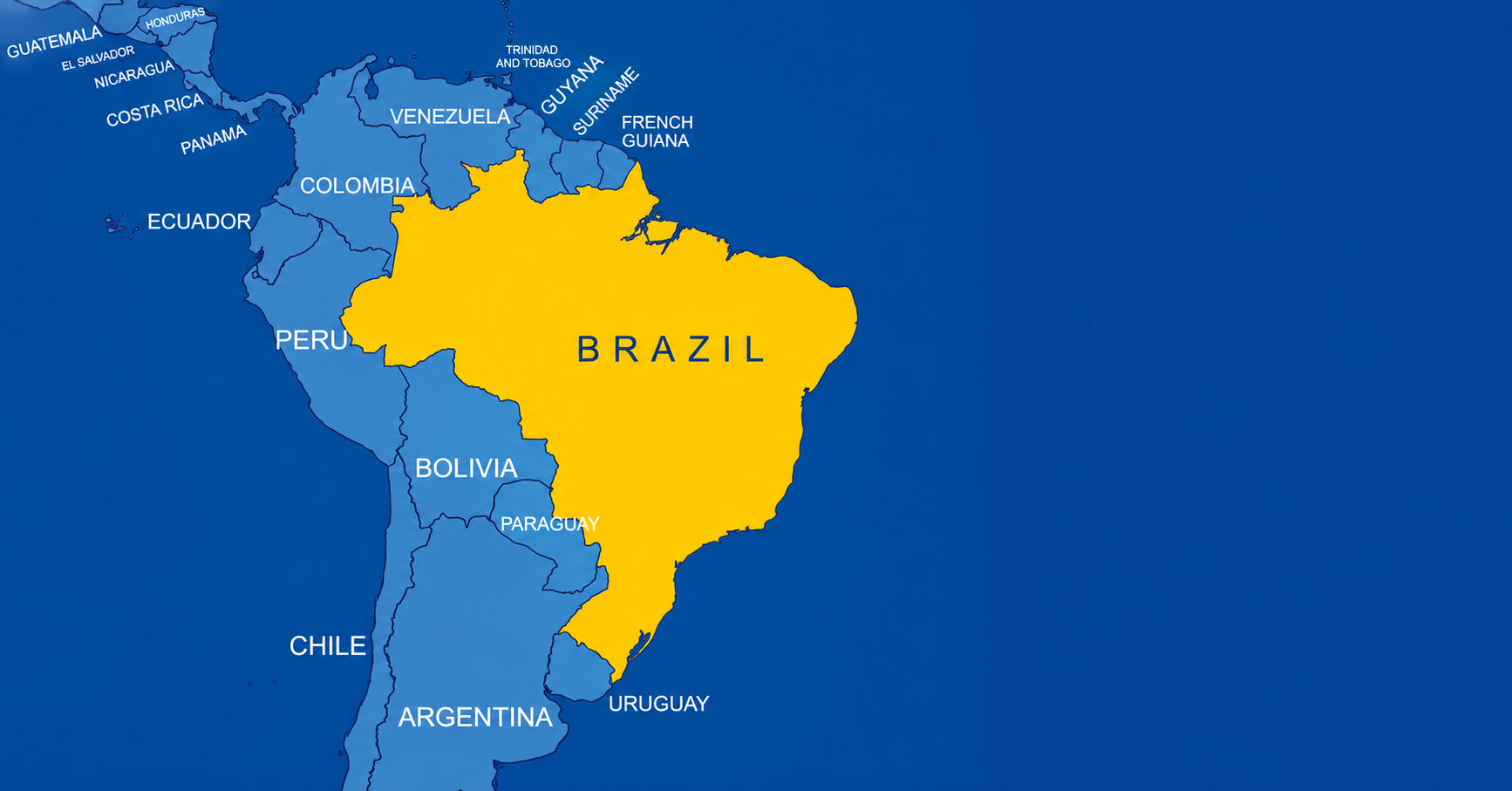

Brazil, with more than 8,5 million square kilometers, is known as the “continent country” due to the great extent of its territory and the magnitude of its internal distances, both north-south and east-west.
Added to this is an extensive coastline on the Atlantic Ocean and a wide network of land borders that link it with virtually all the countries of South America, with the exception of Chile and Ecuador, which positions it as a central actor in the dynamics of regional integration.
In this context, these data are not merely geographical: they reflect the scale and complexity of foreign trade flows in the region, where logistical connectivity and regional coordination acquire strategic relevance for competitiveness and trade facilitation.
This was stated by the Executive Coordinator of PROCOMEX, John Edwin Mein, during the opening of a virtual event, in which it was highlighted that the initiative arose as an alliance driven by business associations, with the vision that "countries can be more competitive if they have more agile, homogeneous and reliable customs and logistics processes."
Within this framework, the PROCOMEX Institute —created in 2005— was presented as the operational arm of this alliance, with the mission of promoting the building of social capital and the articulation between the public and private sectors to strengthen trade facilitation.
For their part, representatives of the World Bank highlighted the strategic role of coordinated border management as one of the fundamental pillars for improving competitiveness, reducing logistics costs and accelerating the flow of international trade.
World Bank Group Senior Trade Facilitation Specialist Ernani Checcucci noted that borders should be understood as “complex socio-technical infrastructures, where logistics services and sovereign state controls converge.”
In the case of land borders, he stressed that their performance depends on both sides of the border crossing, making binational coordination crucial, and warned that "the performance of a border is directly linked to the slowest link in the system," with a direct impact on trade, logistics, and people flows.
Checcucci also emphasized that the efficient coordination of controls on goods and passengers is supported by Article 8 of the WTO Trade Facilitation Agreement, which refers to cooperation between agencies operating at borders. This is further supported by instruments promoted by the World Customs Organization (WCO) and international studies aimed at strengthening interoperability and operational coordination between agencies.
In this regard, he pointed out that coordinated border management is one of the main tools for addressing one of the biggest obstacles to competitiveness: inefficiency at border crossings. He explained that these delays generate millions in logistical additional costs, as well as impacting the safety and well-being of people.
Border management models
During the exhibition, two major international models stood out.
On the one hand, the coordinated management borderless, predominant at the global level, based on cooperation between agencies, exchange of information and interoperability of processes.
On the other hand, the model of integrated management, applied in a small number of countries with a strong focus on security, where a single agency concentrates all border controls.
At the international level, the growing trend towards inter-institutional coordination schemes, operational agreements and systems integration was also highlighted.
International implementation cases
The presentation included concrete examples of different levels of maturity in coordinated border management.
En Guatemala-Honduras The implementation of a single foreign trade declaration (FYDUCA) was highlighted, where the operator makes a single registration that functions simultaneously as export and import, significantly reducing crossing times.
In the Nordic countriesParticularly between Norway and Sweden, a high degree of institutional integration was mentioned, with advanced interagency cooperation and even schemes in which authorities of one country operate within the systems of the neighboring country.
The case of United States, Canada and Mexicowhere safe trade programs and trusted operators were developed, with differentiated lanes and mutual recognition mechanisms for low-risk operators.
En Southern AfricaThe binational coordination model applied between Lesotho and South Africa made it possible to reduce crossing times from approximately six hours to less than twenty minutes.
These cases reflect different levels of evolution, from initial interoperability schemes to highly integrated models of border operation.
Digitization, data and risk management
Another central focus was the use of digital tools as enablers of trade facilitation.
The need to move towards common data models among agencies, anticipation of information, and coordinated risk analysis was highlighted.
In this scheme, border control is redefined: risk assessment is carried out before the arrival of the goods or vehicle, allowing only specific verification or release decisions to be made at the border.
In some countries, it was noted, “more than 90% of cargo can be released without physical inspection,” which structurally transforms the operational functioning of borders.
Towards the XII OAS International Seminar
This debate takes place in the lead-up to the XII OAS International Seminar, which will be held on the days May 27 and 28 in BrazilOrganized by the PROCOMEX Institute and the Federal Revenue Service.
The 2026 edition, under the motto “Connections for secure, efficient and compliant international logistics”, will focus on interoperability, digitalization, risk management and regional logistics competitiveness.
To that end, the meeting will bring together representatives from the private sector and the main institutions responsible for logistics and customs governance in Brazil and the region, including the Brazilian Federal Revenue Service (RFB), the Secretariat of Foreign Trade (SECEX), the Ministry of Agriculture and Livestock (MAPA), the National Health Surveillance Agency (ANVISA), the Brazilian Ministry of Foreign Affairs (Itamaraty), as well as the World Bank, the IDB and the Organization of American States (OAS), along with other regulatory bodies and entities linked to foreign trade and logistics infrastructure.
Key themes include public-private integration, process modernization, strengthening of AEO programs, and inter-institutional cooperation, within the framework of a seminar that, since 2014, has become a benchmark forum for discussing and promoting the evolution of foreign trade and regional logistics efficiency, in a context where coordinated border management has become a central component for Brazil and its trading partners, including Argentina.
OAS Event 2026https://eventiza.com.br/evento/evento-oea-2026

Aduana News is the first Argentine customs newspaper to launch its digital version. With 20 years of experience, its publications and initiatives aim to provide the most relevant knowledge on customs issues in order to contribute to safe trade in the region.